
.png?width=1200&height=628&name=Spherene%20blog%20(1).png)
How ADMS geometry changes the equation for protection, drones, field tooling, and thermal management
The defense sector has spent decades optimising the outside of its components. The next performance frontier is internal geometry. Here is how ADMS changes the equation for protection, propulsion, and field readiness.
Additive manufacturing has been finding its footing in defense for some time now. Prototypes first, then tooling, then components that were too complex to machine and too expensive to cast. It has moved in carefully, as it should in a sector where qualification is rigorous and the margin for failure is narrow.
But something is shifting. The conversation has moved from whether AM belongs in defense to how to use it better. Engineers who spent years learning to design the process are now asking a different question: now that we can specify exactly what goes inside a part, layer by layer, what should we put there?
That question turns out to be more consequential than it first appears. The interior of a structural component carries load, absorbs impact, conducts heat, and determines how a part fails. For most of manufacturing history, those properties were a consequence of outer geometry and material choice. AM makes them a design decision. And in defense, where mass, protection, thermal management, and field repairability all compete for the same envelope, that design decision matters.
Spherene’s ADMS (Adaptive Density Minimal Surfaces) is a patented internal geometry built around that idea. It adapts continuously to the load field of a part, and it is finding early traction in four areas where defense engineers are beginning to push AM design further than off-the-shelf infill approaches allow.
The conversation has moved from whether AM belongs in defense to how to use it better. What you put inside a part, it turns out, matters more than most engineers expected.
How Spherene Changes the Calculation
ADMS is a patented minimal surface geometry that adapts continuously across a part’s volume, guided by the actual load field. High-stress zones get denser internal geometry. Low-stress zones stay light. The surface connects continuously, wall to wall, which means load redistributes through the network before any single zone reaches failure. The result is progressive, controlled energy dissipation rather than sudden collapse. In impact-critical applications, that is the difference between a part that protects and one that gives way.
Validated under dynamic and quasi-static loading conditions, ADMS delivers measurable, consistent results across the conditions that matter most in defense.
This also means performance is tunable. Change the density field, and you change how the part behaves, stiffer here, more absorptive there, all within the same mass budget and outer geometry. For defense applications where requirements vary across variants or threat profiles, that flexibility matters.
Four Defense Applications Where This Changes Things
01. Protective Apparel
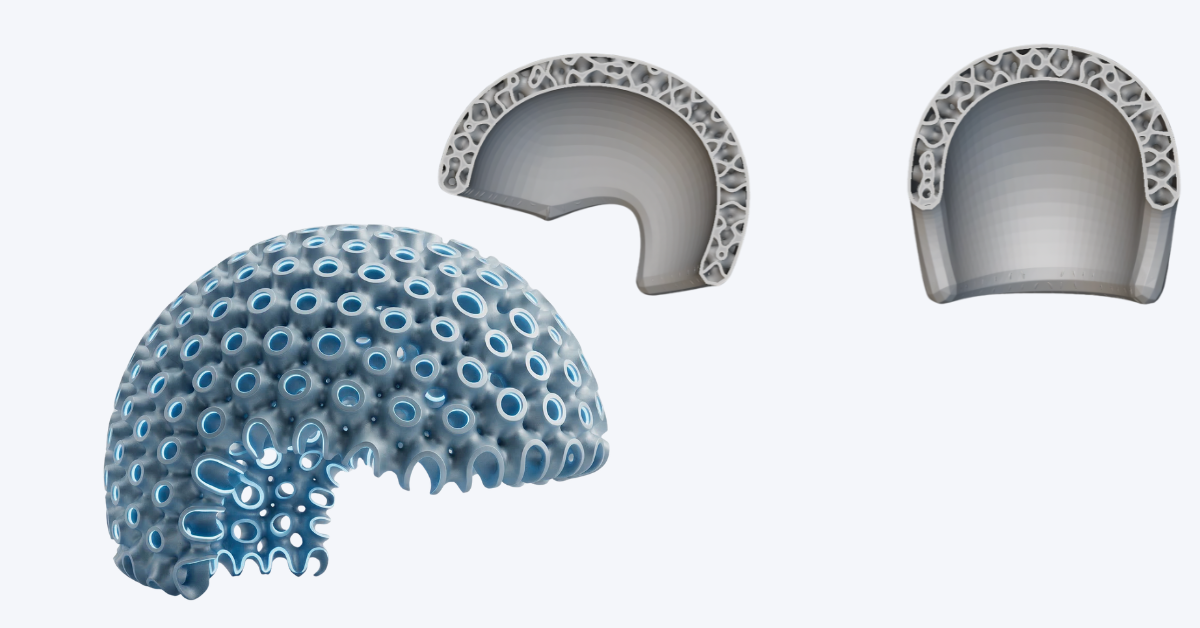
Current helmet liner systems rely primarily on foam energy absorbers that have a single absorption profile. They are optimised for one type of impact, at one velocity range, across a uniform geometry. The problem is that blast, ballistic, and blunt-force impacts are not uniform, and neither is the human head.
ADMS internal geometry can be designed zone by zone, with denser infill in high-risk impact zones and lighter geometry elsewhere. Because the surface connects continuously, energy is redistributed laterally rather than localized at the point of impact. The same geometry can conform to any three-dimensional shell form, making it directly applicable to helmets, body armour backing plates, knee and elbow systems, and any protective shell that currently relies on passive foam for energy management.
The potential extends beyond off-the-shelf protection. With AM production, protective geometry can be tuned to an individual’s anthropometric data, or to a specific threat profile, without retooling a production line.
- Higher protection at lower weight
- Progressive failure, no sudden collapse
- Adapts to any form factor
- Polymers, composites
02. Drones & Unmanned Systems
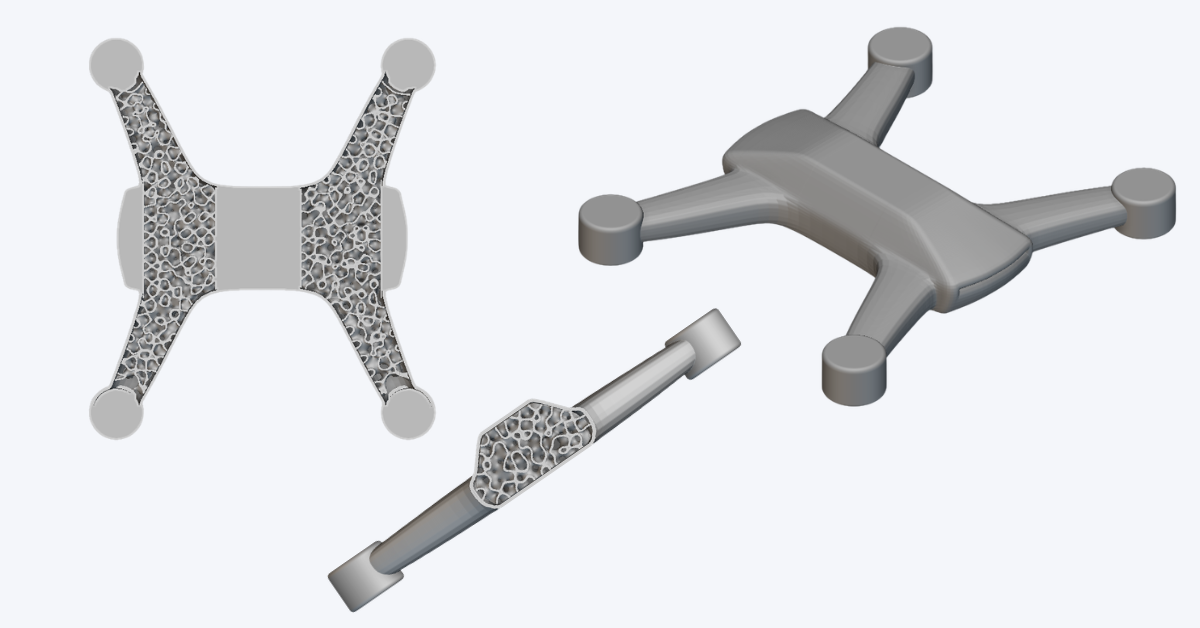
The global increase of unmanned aerial and ground systems has created an acute engineering tension: platforms need to be lighter for range and endurance, but robust enough to survive rough handling, hard landings, and in some applications, combat damage. Conventional structural approaches force a compromise between the two.
ADMS structural components carry the same load as solid equivalents at a fraction of the mass, with a failure mode that is progressive rather than sudden. For a drone frame or housing, this means that a hard landing or impact event that would shatter a conventional structure instead compresses the internal surface network layer by layer, preserving form and function far longer.
ADMS geometry is self-supporting during additive manufacture. Minimal build supports mean shorter print cycles, less material waste, and faster turnaround from file to flight-ready component.
- Lighter frames, longer range
- Progressive failure, no sudden collapse
- Minimal print supports
- Designed within different AM processes.
03. Lightweight Field Tooling & Structural Components
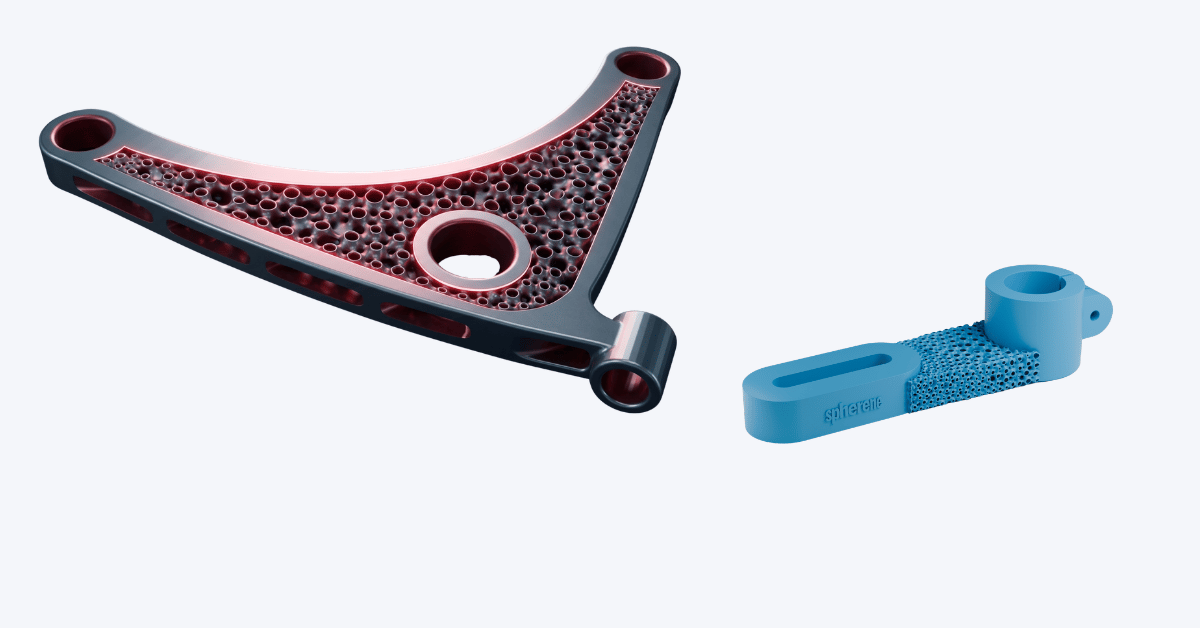
Forward-deployed manufacturing is no longer a theoretical concept. Several NATO member states are actively piloting distributed AM capability for spare parts, jigs, fixtures, and structural components at or near the point of need. The challenge is that the components produced need to match or exceed the performance of their conventionally manufactured equivalents, at a print time and material cost that makes field production viable.
ADMS geometry is designed for this context. Because it is self-supporting and requires minimal post-processing, components move from file to usable part faster than conventional infill strategies. Because the geometry adapts to load, the resulting parts are not simply lighter but structurally appropriate, carrying exactly what they need to carry without unnecessary mass.
- Faster production ready cycles
- All AM-compatible alloys
- Design iterations completed in hours, not days
04. Thermal Management & Heat Exchangers
Electronic systems, propulsion units, and high-cycle weapons platforms all share a common challenge: heat. As system density increases and operational cycles shorten, thermal management becomes a primary design constraint rather than a secondary consideration. Conventional plate heat exchangers are large, heavy, and designed for a single thermal function.
SphereneHEX (Special geometry designed for heat exchangers) applies flowADMS geometry to heat exchanger design, creating directional internal flow channels that balance heat transfer efficiency and pressure drop within a single printed part. The same component that manages thermal load can simultaneously carry structural load and dampen vibration, reducing part count and integration complexity.
Compared to conventional plate heat exchangers, SphereneHEX achieves size reduction. It delivers lower pressure drop at equal thermal performance.
- Size reduction vs plate HEX
- Structural, vibration, thermal and functionality in one part
- Flow channels optimized for thermal efficiency and minimal resistance
- Compatible with aerospace-grade metal alloys
.png?width=1200&height=628&name=Spherene%20blog%20(3).png)
What This Requires from the Engineering Workflow
Implementing ADMS geometry does require adopting a new design approach. It is computed from an input envelope and a density field via Spherene plugins that integrate directly into the CAD tools engineering teams already use: nTop, Autodesk Fusion, Rhino, and Grasshopper.
The learning curve is real but shorter than most engineers expect. Customers have reported design cycles shortened by up to 10x compared to traditional internal structure approaches. The plugins require no new hardware and fit into existing workflows. For organisations that want to evaluate fit before commitment, a 10-day free trial is available with no procurement overhead. A detailed onboarding process, done by our professional team will ensure your engineers get comfortable with the tool before starting using it.
For teams working on defense-specific materials and load conditions. Simulation fidelity against physical test results has come in under 5% deviation for frequency response across the validated bracket geometry.
The geometry is not the final product. The final product is a component that is lighter, stronger, and cheaper to manufacture than what came before. ADMS is the path between those two points.
Where We Are Going Next
The four applications covered in this post are the starting point for what ADMS can achieve in defense. If you are an engineer, programme manager, or procurement lead working on a specific challenge, the right starting point is a conversation. Reach out to info@spherene.io and we can look at your geometry together.
Explore the potential of Adaptive Density Minimal Surfaces in your next project.