
For a long time, product design operated under a quiet but firm assumption: a part is either solid or hollow. Solid meant strength. Hollow meant lightweight. Everything in between was usually shaped more by manufacturing constraints than by design intent.
Additive manufacturing changes that. Internal volume is no longer inaccessible or simply void. It can be designed, controlled, and tuned to support specific performance goals.
What matters now isn't whether a part is solid or hollow. It's what the structure inside is actually doing.
Moving Beyond Binary Thinking
Traditional manufacturing, machining from casting into molds, made internal complexity either impossible or expensive. As a result, internal structure was rarely treated as an active engineering decision. Material was either present or removed.
Additive manufacturing removes that constraint. But simply hollowing a part isn't a strategy. Removing material without controlling how the remaining structure behaves can reduce mass, but it can also introduce uncertainty in stiffness, load transfer, and failure behavior. A more effective approach is to treat internal architecture as a design variable.
That's the idea behind Spherene's Adaptive Density Minimal Surfaces (ADMS), a continuous, parametrically controlled internal geometry that enables local density variation without discrete cell repetition. Unlike traditional lattice structures or infill optimization approaches, ADMS doesn't rely on repeating a fixed cell pattern; it generates a continuous surface that adapts throughout the volume.
.png?width=1280&height=720&name=ADMS%20vs%20gyroid%20(1).png)
Left: Lattice Structure, right: ADMS structure
Internal Volume as an Engineering Parameter
In most design workflows, wall thickness is a parameter; external shape is a parameter. Internal architecture should be one too.
Unlike many conventional infills, which are often adjusted by scaling or stretching a repeated cell, ADMS is not limited by a fixed cell-size logic. In many cell-based approaches, tuning effective density can also change or distort the geometry of the cell itself or force local thickening or thinning of walls. With ADMS, internal structure is controlled through a defined set of inputs: the envelope geometry, density field, Density Reference Thickness (DRT), surface bias, and wall thickness. Together, these let designers specify not just how much material exists inside a part, but where it is, how it's distributed, and how it transitions.
In practice, this enables reinforcement along primary load paths while reducing material in low-stress regions, all within smooth gradients that avoid the stress concentrations that come with abrupt transitions.
With the addition of Scatter Vector (introduced in Spherene V3), engineers can now introduce controlled anisotropy. Rather than a uniform internal structure, the geometry can be stretched or biased in specific directions to match directional loading, without losing the overall structural integrity of the system.
Internal volume becomes something you can design with precision, not just fill.
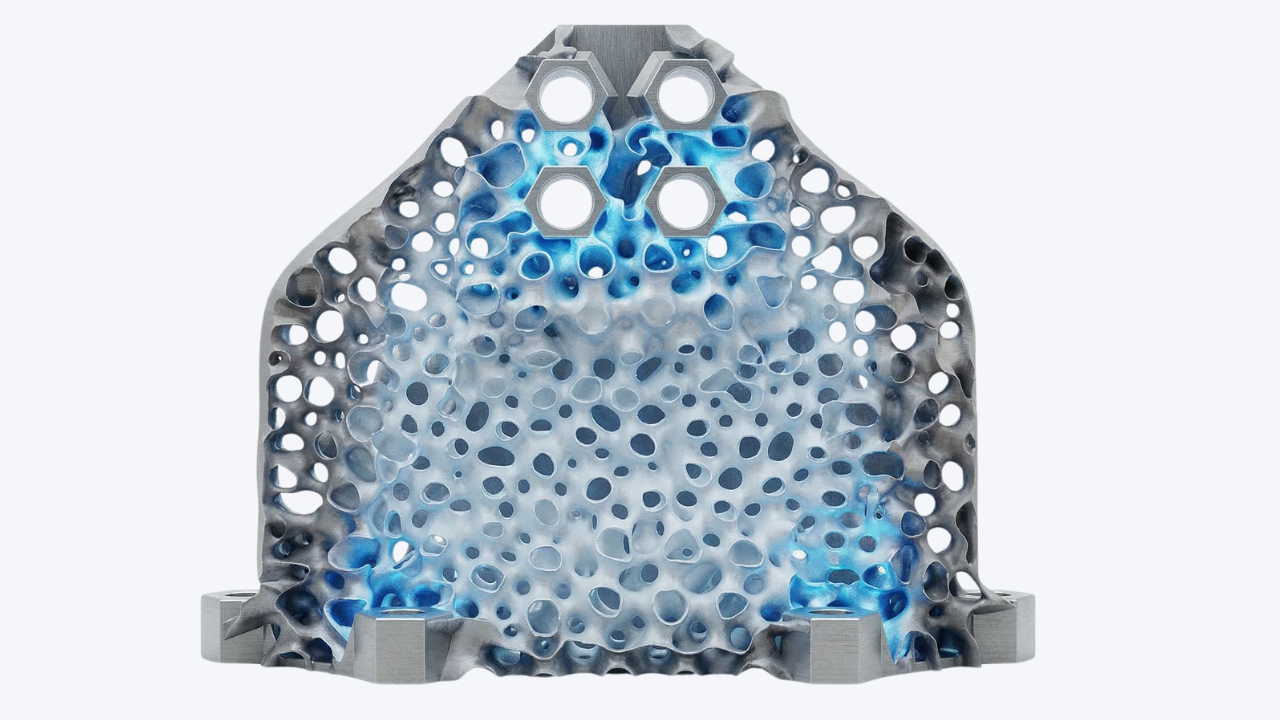
ESA bracket with Spherene
Geometry as a Driver of Mechanical Performance
Geometry determines behavior. This isn't a principle unique to Spherene, it's a foundational idea in structural engineering. What ADMS does is give designers the tools to act on it at the internal level.
Spherene’s workflow is built around the idea that designers should be able to control variables such as density, thickness, and surface bias directly, rather than manually building, scaling, and trimming repeated internal cells. The goal is not just to place material inside a volume, but to control where it is placed, how it is distributed, and how it transitions across the part.
ADMS degrades gradually. surface conformity improves boundary load transfer: by meeting the boundary in a well-aligned manner, it reduces geometric mismatch, limits stress concentrations at unfavorable angles, and promotes a more uniform stress distribution. For safety-critical applications, predictable failure behavior is as important as raw stiffness or strength.
This has been confirmed in real conditions. In the ESA OSIP study, it was physically tested ADMS brackets in AlSi10Mg via laser powder bed fusion. Harmonic vibration tests showed less than 5% deviation between simulated and measured natural frequencies across all three modes: first bending, second bending, and first torsional. ESA confirmed that ADMS geometries are predictable, producible, and mechanically robust for aerospace applications.
Geometry-driven performance isn't theoretical. When internal architecture is controlled with precision, the results are measurable, repeatable, and independently verified.
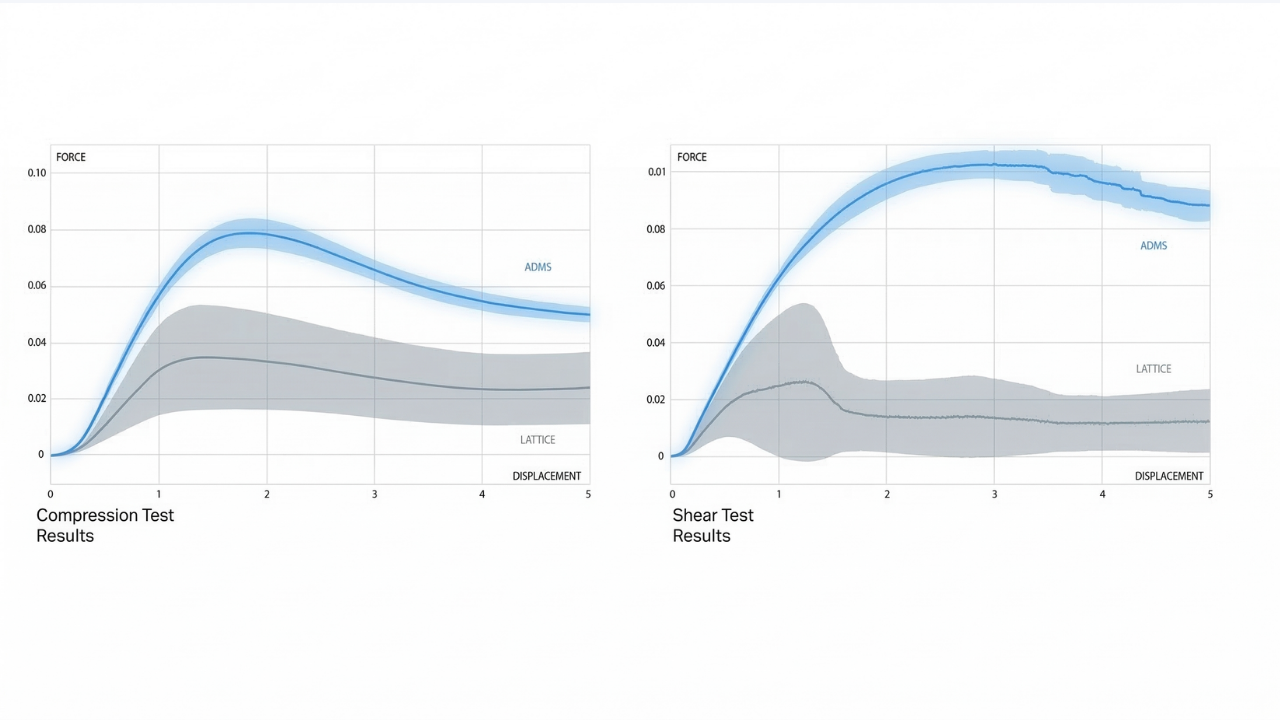
Compression and Shear test results using Spherene and traditional latttice
Thermal and Fluid Performance: Multifunctionality from the Inside
Internal geometry doesn't only affect structural behavior. It also shapes how heat and fluids move through a part.
Minimal surfaces inherently divide a volume into two independent labyrinths; what engineers working with heat exchangers would recognize as dual fluid channels. This makes ADMS well-suited for multifunctional parts that need to handle both structural loads and thermal management simultaneously.
With Flow ADMS, Spherene extended this further. Flow ADMS is a minimal surface geometry specifically optimized for heat exchanger applications. The internal architecture can be shaped and optimized not only for mechanical continuity, but also for hydraulic efficiency.
With Flow Direction, designers can define preferential flow paths in specific directions. This means pressure drop, flow balance, and thermal behavior can be influenced through the same design logic used to control structural response.
Structural integrity and thermal efficiency don't have to be solved separately. They can be co-designed within the same internal architecture. They can be co-designed within the same internal architecture.
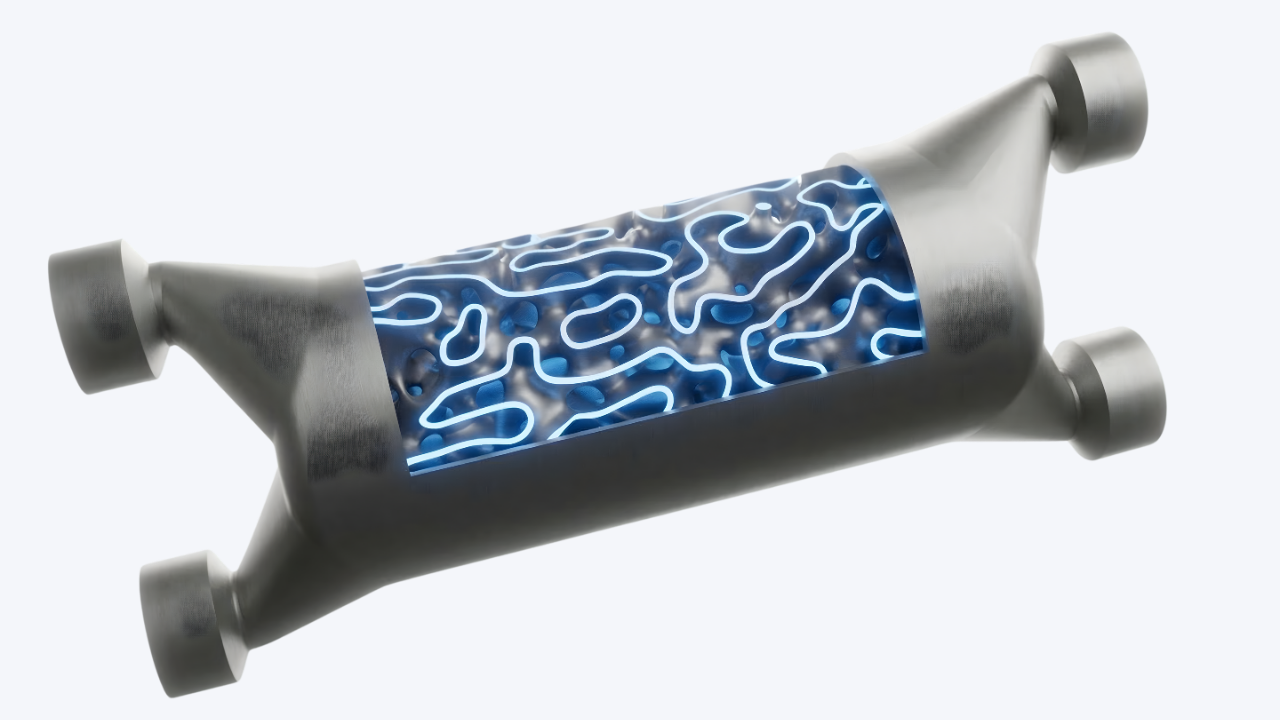
Heat Exchanger designed with Spherene
Internal Structure as Design Intent
Historically, internal structure was decided late, often after external geometry was already completed. In additive manufacturing, this sequence is inefficient. When it is treated as a design variable from the beginning, it can evolve together with the outer form and contribute directly to the performance targets of the part. Treated early enough, it shapes the outcome just as much as external geometry does.
Spherene integrates directly into the CAD environments where design decisions happen: Rhino, Grasshopper, Autodesk Fusion, and nTop.
This inside-out approach is especially valuable in additive manufacturing because the internal volume is one of the few design spaces where significant performance gains can be unlocked without changing the external envelope. Weight, stiffness, flow behavior, thermal response, and manufacturability can all be influenced by decisions made inside the part.
The result is fewer redesign loops and a clearer line between design intent and final output.
What This Means in Practice
Treating internal geometry as a controllable variable changes the scope of what's possible in product development.
Whether the constraint is weight, stiffness, heat transfer, or impact response, the lever is the same: control over internal architecture. Most design workflows don't treat that as a variable. ADMS does.
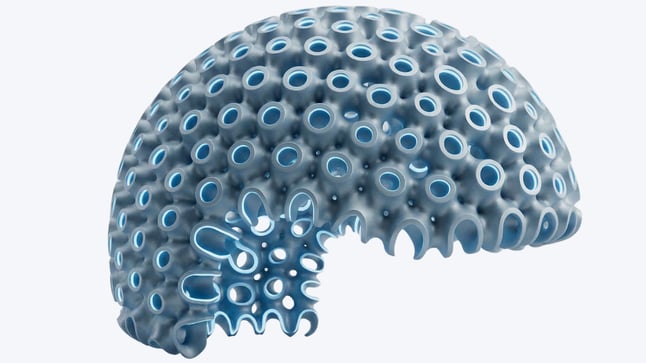
Internal Spherene Structure of Helmet
Designing from the Inside Out
The next phase of additive manufacturing isn't about printing more complex shapes on the outside. It's about engineering what happens on the inside.
Solid versus hollow was never really a design decision. Continuous internal architecture is. When internal structure becomes a primary design variable, you stop optimizing by removing material. You start optimizing by placing it precisely where it needs to be.
Contact us for your specific use case: info@spherene.io

Student? Register here